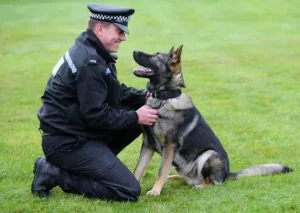
The night felt empty. A warehouse hummed with its own small life: a fridge motor, a distant truck, the soft tick of a light. The guard relaxed, but the dog did not. It lifted its nose, then froze. The handler followed the line of its stare and found a shadow tucked behind a pallet. No movement, and no noise. Just a hidden person and a dog that had already noticed them. This is not luck. It’s a system.
Security dogs detect hidden intruders by reading thin, layered signals we barely sense. They turn tiny cues into clear leads. Strange, but true: a dog’s body is part instrument, part detective. This piece explains why, from basic biology to advanced sensory patterns that make detection reliable.
Natural Instincts Behind a Dog’s Detection Abilities
Dogs are built to sense what we miss. Their biology gives them an edge.
Scent Sensitivity as a Biological Superpower
Dogs carry a vast olfactory toolkit. They have far more scent receptors than humans. They also use the vomeronasal and Jacobson’s organ, which help process pheromones and subtle chemical cues. A patch of skin cells, a smear of sweat, a breath left in a corner: all become data. Dogs sort this data by age and strength. Fresh scent pulls them in; trace scent points to past passage. They can tell if a person passed minutes ago or hours ago. That timeline matters in security work.
Low-Frequency Hearing and Vibrational Perception
They hear low tones we miss. A slow footstep. The soft drag of fabric. Even the tiny thump of a person shifting weight on a crate. These are pressure waves. Dogs sense them through their ears and paws. Floors carry faint vibrations. A dog standing still can feel a change underfoot; however, that vibration often precedes sight.
Environmental Mapping Through Spatial Micro-Cues
Dogs also read space. Warm pockets of air rise. Cool drafts sink. Air moves weirdly around objects and bodies. Dogs detect these micro-currents and build a mental map. If the map shows a gap, a space that should be empty but is not, the dog treats that gap as suspicious. Call it “canine spatial logic.” It’s instinct, yes, but sharpened by experience.
Advanced Sensory Patterns Used by Expert Security Dogs
This is the heart of detection science. Trained dogs do not rely on one sense. They use patterns, stacking, weighting and predicting. Below are four layered processes they use. Each blends biology with trained routine.
Layered Scent Pattern Analysis (Multi-Phase Olfactory Sequencing)
Think of scent as a layered signal. There is the top layer: intense, fresh odour. Beneath that, faded traces, masked or mixed smells. Expert dogs learn to parse these layers quickly. Trainers introduce controlled “olfactory noise” cleaning agents, vehicle smells, and food, then place a human scent so the dog learns to find the target through clutter.
Dogs apply what we can call olfactory noise filtering: they dampen background scents and amplify the novel chemical signals. They also use “chemical attentional weighting.” They prioritise smells that fit the profile of a hidden intruder. Tiny eddies form around a person hiding in a corner. Air curls. Scent density shifts around the hiding spot. The dog reads that density and follows the scent vector to its source.
Micro-Acoustic Pattern Recognition (Low-Energy Noise Mapping)
Sound is more than volume. Dogs map micro-acoustics:
- Subtle pressure of breath,
- Soft rasp of fabric,
- Rhythm of a held-in heartbeat.
In a room, they detect acoustic shadows: areas where sounds don’t behave as expected. A person curled behind packing generates irregular micro-noise. Dogs use temporal filtering to ignore steady background rumbles and flag irregular, human-origin signals. Where scent gives a line, micro-sound provides timing. Paired, they narrow the location within seconds. This rapid pairing is why security dogs detect hidden intruders faster than a lone sensor.
Environmental Distortion Detection (Airflow, Gravity, Thermal Pockets)
Airflow patterns change when a body blocks, compresses or warms a channel. Dogs sense those distortions. Warmth pockets, even minute thermal gradients, alter how scent moves. A hidden person creates a micro-thermocline. Dogs do not see the warmth like a camera. They sense its effect on the air and scent.
When currents don’t match the room’s baseline, dogs call it “dissonance”, a cue to investigate. Gravity plays a role too: the weight of crates shifts slightly when someone leans on them. That shift works with airflow to produce a signature dog’s read.
Cognitive Pattern Mapping and Intruder Prediction (Sensory Fusion Processing)
All senses merge in the dog’s mind. Scent, sound, airflow and touch fuse into a model of the space. From that model comes a prediction. Dogs anticipate where a person might shift, how they might move to stay concealed. Trainers build this skill by repeating scenarios, then rewarding accurate predictive behaviour.
Dogs also imprint short-term scent memories. They recall a signature a few seconds or minutes later and use it to track inconsistencies over time. The result is predictive tracking: dogs do not just follow clues; they forecast likely positions and check them proactively.
How These Sensory Patterns Guide Real-World Detection
Patterns become actions. In the field, dogs show distinct behaviours that handlers read instantly.
Silent Airflow Tracking in Enclosed Spaces
In tight rooms or crawlspaces, scent and air move oddly. A dog will pause, nose low, and follow the thin waft that creeps out from under a cover. That pause is deliberate. The dog is reading the folding air.
Following Scent-Inconsistency Lines
A warehouse has a baseline scent: forklifts, packaging, and staff. A hidden person adds a mismatch. Dogs detect lines of inconsistency and follow them. They trace the scent like a thread. Often, that thread leads to a place you would never guess.
Alert Communication Between Dog and Handler
The cues are micro: a frozen stare, a slow tail stop, a subtle lean. Handlers learn each dog’s vocabulary. No loud barks needed. A tiny signal saves searches and reduces risk.
Biological vs Mechanical Detection Limits
Machines are precise, but they need clear inputs. Cameras need a line of sight. Thermal sensors need contrast, while motion sensors need movement. Dogs eat ambiguity. They thrive on mixed signals. Their biological fusion of senses processes messy, layered data in real time. That gives them an edge in crawlspaces, behind stacked goods, or under tarps, places where tech often fails. Not every situation needs a dog. But many do.
Conclusion
Skilled detection dogs are not simple scent trackers. They are living, adaptive systems. They sort layered smells, map micro-sounds, sense airflow quirks and predict movement from a few scattered clues. Training turns raw instinct into reliable pattern work. That is why security dogs detect hidden intruders with a calm, steady craft that technology alone rarely matches. It makes you wonder how much slips by when we rely only on machines and how much safety can change when we pay attention to what a dog already knows.
Frequently Asked Questions
1. How do detection dogs process scent so fast?
They filter background odours and weight novel scents by intensity and timelag.
2. Do dogs rely more on hearing or smell?
Smell usually leads, but hearing and vibration add crucial timing and location data.
3. Can a dog find someone who isn’t moving at all?
Yes. Stillness alters airflow and scent drift; dogs pick up those changes.
4. Are certain breeds better at layered sensory analysis?
Many breeds excel; working lines (Malinois, Labradors, GSDs) are common due to drive and focus.
5. How long does pattern-recognition training take?
Often one to two years for high-reliability detection, with ongoing scenario work.