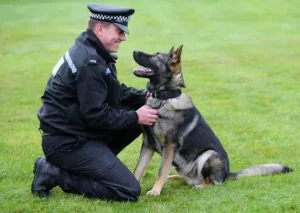

Dogs react to danger with a speed that often feels uncanny. Long before a human registers a change in the room, a trained K9 may shift its stance, lift its head, or track a faint disturbance that barely exists to us. This isn’t guesswork or instinct alone.
It’s a field now recognised as dog threat detection science, a discipline exploring the biological and neurological forces behind their rapid alerts. When you break it down, dogs operate inside a richer sensory world, sharper smells, deeper sound ranges, and a brain built for swift interpretation. Understanding that science reveals why they remain unmatched in early threat detection.

Understanding Dog Threat Detection Science
What Makes Canine Senses Fundamentally Different From Humans
Dogs don’t prioritise their senses the way we do. Humans rely on sight first, while dogs rely on scent. Their world begins with smell, moves through sound, and ends with vision. That order shapes how fast they read a situation. They catch faint edges of chemical change and quiet vibrations before the human brain even starts processing. This ability comes from a long evolutionary path shaped by survival.
Wild canines needed early warning cues to avoid danger or track prey. Modern working breeds inherited that design, giving them sensory strengths humans simply don’t possess. And unlike human perception, canine sensory processing doesn’t get overwhelmed as quickly.
The Biological Edge: Why Dogs Sense Danger Before We Do
The Canine Olfactory Superstructure
A dog’s nose is more than a nose. It’s a full-scale biological system built for threat detection. With up to 300 million scent receptors, compared to our 5–6 million, dogs operate as natural analysers. Their olfactory bulbs are much larger, allowing complex scent identification far beyond human ability. They can separate a mixed scent into parts, a process tied to K9 scent discrimination.
Their vomeronasal organ gives them a secondary channel that reads pheromones, stress chemicals, vapours from explosives, accelerants, and even hormonal changes in people. This is where the canine olfactory advantage becomes obvious; it lets them read the air as a layered and detailed map.
Olfactory Memory and Pattern Retention
Dogs don’t simply detect smells; they remember them. Their olfactory memory is deep, long-lasting, and surprisingly structured. This memory is central to biological threat detection in dogs. When a dog encounters a known scent signature, such as fear hormones, chemical residues, or unusual environmental compounds, it can match it to previous patterns.
Over time, this builds an internal archive, supporting rapid dog sensory mapping. A dog might remember the faint trace of an accelerant weeks after exposure. This stored memory becomes a reference system for quick comparisons, helping the dog detect anomalies faster than we process visual information.
Sensory Processing Speed: Detecting Micro-Changes Before Humans Notice
Acute Hearing and Vibrational Awareness
Dogs hear frequencies and vibrations that fall far outside human recognition. A soft click behind a wall. A distant shift in metal tension. The light rasp of fabric as someone adjusts their stance. These sounds give dogs early clues, forming an important part of canine sensory processing.
Vibrations travel through surfaces, and dogs notice them through subtle pressure changes. Something as simple as the way air moves before a door opens can alert a dog. This sensitivity feeds their canine environmental awareness, enabling early detection in environments where silence normally hides intent.
Pre-Attentive Processing: Identifying Danger Without Conscious Analysis
Humans analyse before reacting. Dogs react while analysing. Their brains use pre-attentive pathways that register anomalies without requiring conscious thought. That’s why a dog’s response often feels instant. The brain catches something out of place, an odd scent layer, a quickened pulse in a nearby person, or a subtle movement pattern and triggers action.
This neuro-fast system forms the basis of canine neural response systems. It explains why dogs remain steady under pressure and why their dog’s early-warning response is so dependable. The reaction isn’t emotional. It’s built into their wiring, a biological shortcut created by evolution.
Behavioural Science: How K9s Read Human Stress and Environmental Threat Signals
Detecting Stress Markers and Subtle Human Cues
Humans leak information when stressed. Raised cortisol, adrenaline spikes, and small behavioural tells create a pattern dogs understand better than we do. This forms a large part of behavioural detection signals in dogs. They pick up on tightened shoulders, shifting gait, or even a sudden lack of movement.
Combine that with the chemical cues floating off the skin, and you have a species uniquely capable of sensing emotional disturbance. This deep link between smell and behaviour supports their canine perception of danger, letting them catch risk in the hidden spaces between actions.
Pattern Recognition and Environmental Mapping
Dogs also map environments in a quiet, steady way. They study what “normal” looks like: the usual scents, common movements, familiar sounds. Over time, they build a baseline. When something shifts a new object, a changed scent trail, a strange vibration, they flag it almost immediately. This is behavioural science, not training.
Dogs rely on recognition of pattern disruption. Their canine environmental awareness works like a continuous scan, always updating. When that scan detects something off-pattern, the dog reacts. Humans often miss these small deviations entirely.
Neural Efficiency: Why K9 Brains React Faster Than Human Brains
Direct Fight-or-Flight Activation
Humans hesitate during threat recognition. We think, evaluate, and second-guess. Dogs don’t. Their amygdala jumps straight to response. This direct pathway creates threat recognition behaviour in dogs that appears instantaneous. The reaction doesn’t need conscious approval.
A dog smells, hears, or senses something wrong, and the nervous system fires off a response. That speed is a key part of why security dogs outperform technology and humans in early threat detection. The body acts before the mind finishes interpreting the danger.
High-Speed Sensory-Neural Integration
A dog’s brain pulls scent, sound, and behaviour into a single stream of information. Humans treat these signals separately. This integrated approach forms the core of K9 detection biology. The dog processes changes as a whole picture, not in isolated parts. This fusion helps explain threat detection physiology in dogs, especially in crowded or complex spaces. When something shifts chemically, acoustically, or behaviourally, the brain doesn’t need to collect evidence. It already has what it needs to trigger a reaction.
Detection Conditioning Without Overlap With Training Content
Scientific Reinforcement of Natural Ability
Exposure strengthens a dog’s existing instincts. When they experience different areas, scents, and environments, their brain deepens sensory maps through reinforcement loops. This is biological, not procedural. The brain creates faster connections, supporting stronger canine instinctive threat response without relying on structured drills. Their natural tendencies sharpen simply by encountering varied conditions.
Why Dogs Retain Threat Signatures for Long Periods
A dog may recognise a complex scent pattern long after a human forgets the scene entirely. Their olfactory memory system, especially the parts linked to emotional cues and chemical residues, stores many layers at once. These layers form signatures that the dog can recall quickly. This gives them long-term reliability and a strong edge in environments where old threats can reappear or evolve.
Conclusion
Dogs detect danger faster than humans because their biology is built for it. Their world runs on scent, sound, and subtle changes we rarely notice. The deeper you go into dog threat detection science, the clearer the picture becomes: a species shaped by evolution to act before danger escalates.
From their olfactory strength to their rapid neural pathways, dogs process information in a way humans cannot mirror. They read patterns, sense emotional shifts, and interpret micro-changes that pass unseen to us. This blend of biology, behaviour, and sensory intelligence keeps them at the centre of modern detection work, and it continues to fuel ongoing research into how their abilities unlock safer environments.
Frequently Asked Questions
1. Why do dogs sense danger earlier than humans?
Their sensory and neural systems process scent, sound, and behavioural anomalies instantly, skipping the slow cognitive analysis humans rely on.
2. How does a dog’s sense of smell help in threat detection?
Dogs differentiate scent layers, identify chemical shifts, and recall patterns that indicate substances or stress signals.
3. Can dogs detect emotional changes linked to threats?
Yes. They sense hormonal shifts like cortisol or adrenaline and spot tiny behavioural cues linked to stress.
4. What role does evolution play in canine threat detection?
Generations of survival shaped their senses, sharpening pathways for early danger detection.
5. Are dogs faster at recognising threats due to training?
Training helps consistency, but the speed comes from biology: scent, neural wiring, and instinctive processing.