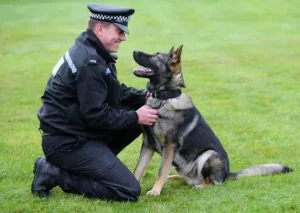
Picture a construction site swallowed by thick fog. The floodlights flicker, then fail. CCTV turns into a grainy grey blur. Radios crackle. Somewhere beyond the fencing, something moves, but no human can say where, or what. A trained patrol dog lifts its head, listens, then walks with quiet certainty toward the threat. In moments like this, dog low-visibility detection reveals its true worth. What felt unpredictable suddenly becomes manageable, even safe.
These dogs don’t rely on luck. They rely on senses sharpened by evolution, refined by training, and trusted by experienced handlers.
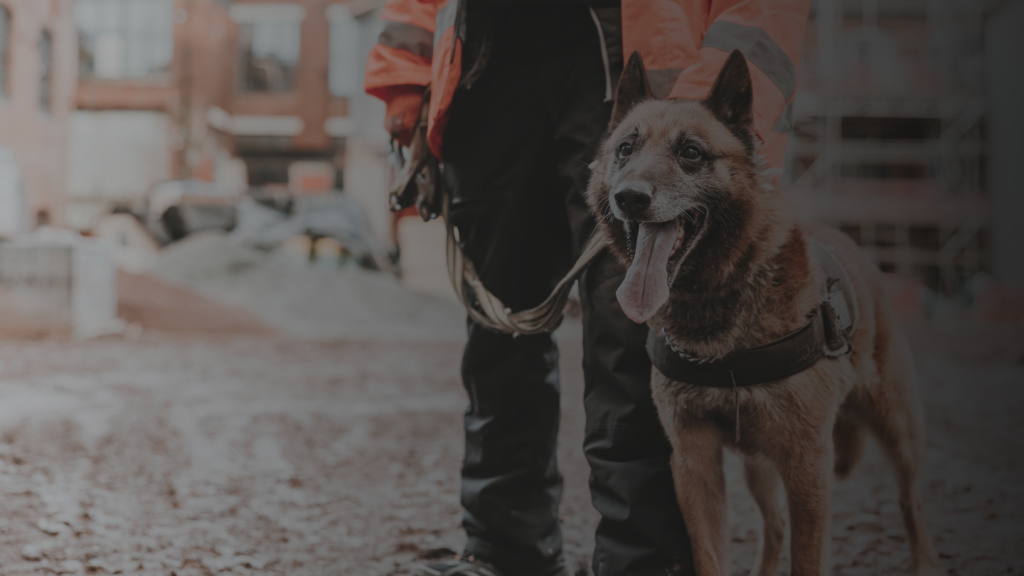
Dog Low Visibility Detection – Nature’s Secret Advantage
Humans like to believe vision is the ultimate survival tool. For dogs, it’s only the beginning. Their eyes are built for dusk, fog, shadow, and distance. A dog’s retina carries a higher concentration of rod cells, the ones responsible for detecting motion in low light. This permits them to detect minor changes that our eyes do not register. Additionally, they have a wider field of view, allowing them to scope an area more broadly without rotating their head.
These roots run deep; dogs are descendants of wolves who hunted in the evening, depending on temporary motion, not defined detail. Today’s working dogs have that same biological advantage; they are designed to work in low-visibility and high-risk areas.
Scent and Sound: The Multisensory Edge
Sight alone doesn’t explain the full story. Dogs possess roughly 300 million scent receptors in their noses, while humans have about five million. Scent moves differently through smoke, rain and dust than light does, enabling dogs to follow intruders that can’t be detected by cameras.
Hearing plays a major role, too. Dogs detect higher frequencies, softer footfalls, distant breathing, shifting fabric, or metal scraping against fencing. Handlers often say dogs “react before they know why,” because instinct processes threat cues faster than conscious reasoning.
Patrol training compounds these abilities. Dogs learn to layer smell, sound, and movement into a single decision, one that often arrives before technology registers anything unusual.
Movement Over Sight – How Dogs Detect Motion When Humans Can’t
In near-darkness, humans scan for outlines. Dogs scan for the slightest ripple in space. Studies show they can identify motion at distances and contrasts that would feel invisible to us. They don’t need a clear silhouette. They notice rhythm, weight shift, gait, hesitation, and the difference between wind-blown debris and deliberate footsteps.
Handlers frequently describe a moment on patrol when the dog stiffens, raises its ears, and stares into “empty” space. Seconds later, a person appears who security didn’t know was there. That anticipatory stillness is part instinct, part processing, part caution. It reflects an internal alert system built for survival.
Case: Patrolling Power Cuts and Smoke-Filled Environments
During storms, generators fail and alarms fall silent. Warehouses may fill with dust or smoke after machinery incidents. In disaster scenarios, motion sensors misfire, and heat signatures blend together. Yet trained dogs remain functional.
They rely on their noses to track intruders weaving through shelving and machinery. They listen for shifting boots or rattling equipment. They interpret subtle directional cues in wind flow or vibration. In chaotic conditions, dogs don’t wait for clarity; they create it.
Security professionals often report dogs locating intruders faster than handheld thermal cameras. Technology can glitch, but dogs improvise.
Training K9s for High-Risk, Low-Visibility Operations
Natural ability forms the foundation, and training builds discipline. K9 units begin with basic obedience, confidence-building, and scent association exercises. Over time, they’re introduced to staged low-visibility environments:
- Fog machines or darkened warehouses
- Variable-light obstacle courses
- Sound masking drills
- Scent trails are disrupted by the weather
- Simulated intruder movements
These sessions teach dogs to trust their senses when visual cues disappear. Handlers learn as well as understanding body language, ear position, tension changes, breathing patterns, tail height, and searching behaviour.
Communication is rarely loud or dramatic. It lives in a slight leash tension, a shoulder turn, a whispered cue. The bond between dog and handler becomes its own navigational system.
Ethical and Safety Considerations
K9s are not disposable security assets; they are living, feeling partners. Professional teams prioritise:
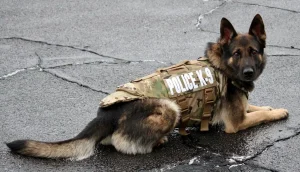
- Protective gear for sharp debris
- Hydration and cooling during long shifts
- Injury monitoring and regular vet checks
- Mental stimulation and rest periods
- Safe pursuit protocols
- Stress and trauma awareness
Any organisation using patrol dogs has a duty of care. Their well-being determines their effectiveness and honours the trust placed in them.
Technology vs. Instinct: Why K9s Outperform Sensors in Real-World Conditions
Security technologies are evolving rapidly; radar, LiDAR, thermal imaging, AI surveillance analytics, and motion-triggered sensors now make up the security arsenal. Although multiple security technologies can be deployed, many have the same problem: they can be impeded by , the interference of the environment.
Fog, smoke, and heavy rain each distort different detection systems. Power cuts, dense fencing, machinery, or vegetation can shut signals down entirely.
Dogs approach detection differently. They don’t rely on a single input channel. They cross-reference senses in real time. They interpret intent, something technology still struggles to define. A dog can tell the difference between a wandering fox and a human trying not to be found.
This doesn’t mean dogs replace technology. The most secure high-risk sites combine both. Surveillance systems provide reach, documentation, and remote monitoring. Dogs provide judgment, mobility, and instinctive threat recognition.
Together, they create a layered security ecosystem stronger than either one alone.
Final Thoughts – The Continuing Value of K9 Movement Detection
In the security world, clarity often disappears when visibility does. Yet trained patrol dogs continue working by reading the environment through smell, sound, vibration, and motion. The resilience of dog low-visibility detection remains unmatched, especially in unpredictable, high-risk environments where a single mistake carries real consequences.
As sites become larger, more complex, and more vulnerable to environmental disruption, dogs remain steady. Not because they are simple tools, but because they are adaptable, thinking partners. Any site manager working in challenging conditions should consider consulting experienced K9 teams, especially when traditional security fails to keep up with reality.
Frequently Asked Questions
1. How do dogs detect movement differently from high-tech sensors in darkness?
Dogs rely on scent, sound, and subtle motion, not just visual contrast, giving them an advantage when sensors lose clarity.
2. What kinds of environments pose the biggest challenge for canine patrols?
Dense fog, smoke, heavy rain, power failures, large industrial sites, and complex construction zones make detection more demanding.
3. How are patrol dogs trained for low-visibility detection tasks?
Through staged drills, scent-tracking exercises, obstacle navigation, environmental conditioning, and consistent handler communication.
4. Can dogs become over-reliant on one sense in difficult conditions?
Good training prevents this by rotating sensory drills and teaching dogs to cross-reference signals rather than depend on one input.
5. What are the typical costs involved in maintaining a K9 patrol team for high-risk sites?
Expenses may include handler fees, training, welfare, equipment, insurance, and operational support reflecting the expertise involved.