When security teams face fast-moving or unclear threats, the real advantage often comes from the simplest source. Dogs outperform security technology not because machines are weak, but because the world is messy. Air shifts. People hide. Signals bounce. Yet a trained K9 pushes through all of that with an ability that feels almost instinctive.
In high-threat situations where machines stall, dogs keep reading scent, movement, intention and tension all at once. Their edge isn’t magic; it’s biology, behaviour, and adaptability working together.
Table of Contents
Understanding the Limits of Modern Detection Technology
Technology has reshaped how we protect people and property. Still, even advanced systems falter when the environment refuses to cooperate. A controlled lab favours machines. Reality often does not.
Why High-Threat Environments Create More False Negatives
In the field, nothing stays still. Airflow shifts around corners in odd ways. Weather twists scent trails. Crowds push air in unpredictable directions. All this movement creates gaps that sensors struggle to interpret. A device might read a space as “clear,” while crucial traces drift just outside its detection cone.
High-threat sites, ports, transit hubs, and dense city blocks create pockets of “sensor blindness.” Rapid environmental swings can break a machine’s rhythm faster than engineers expect. Mixed scents, harsh materials, blocked signals, or foreign noise patterns confuse automation, leading to missed threats at the worst moments.
Situations Where Sensors Fail Under Pressure
Even strong tech shows cracks when the pressure rises. Systems overload in crowds or during fast entry-and-exit cycles. Heat, humidity, or dust distort readings. Electromagnetic interference from radio, scanners, or even structural wiring makes sensors hesitate.
Batteries drain. Calibration drifts. Algorithms misjudge edge-case signals. A device doesn’t “notice” it made an error; it only outputs what it believes is correct. That gap between reality and interpretation is where risk often hides.
The Biological Science Behind K9 Detection Superiority
Dogs don’t need neatly packaged data. They work with the raw world, in all its chaos, and still find clarity.
Multi-Layered Olfactory Processing
A dog’s nose doesn’t behave like a device. Think of it as a multi-channel processor that can pick up individual scent notes, even those sitting below parts per trillion. Dogs don’t just smell a scent; they untangle overlapping odours the way a musician separates instruments in a noisy room.
In chaotic spaces, this ability becomes priceless. Masking agents, decoys, or mixed smells don’t fool a well-trained dog. Their natural discrimination lets them peel apart layers of odour that technology merges into one unreadable block.
Pattern Recognition Beyond Machine Learning
Where machines rely on stored data, dogs evaluate living information. They read micro-movements. Breathing changes act as early stress markers. Variations in human skin scent. Subtle environmental cues that aren’t even on a sensor’s radar.
This blend of sensory and behavioural pattern recognition develops from years of instinct, training, and real-world exposure. While machine learning models need updates to interpret new threat behaviour, dogs adapt in real time, often within seconds.
How Working Dogs Maintain Peak Accuracy in High-Risk Conditions
A high-threat scene rarely gives anyone a second chance. K9 units stay sharp without needing systems, networks, or stable surroundings.
Adaptive Searching Without External Input
Dogs operate without electricity, servers, or recalibration sessions. Their responses shift immediately when terrain changes or when scent trails twist around barriers. If a threat moves, they adjust. If the environment disrupts the odour path, they track the new flow without waiting for instructions.
This instant adaptability keeps them operational even when machines lag or freeze.
Stress-Resistant Performance During Chaos
Sirens scream while lights flash and the crowd shifts in panic. Smoke spreads, and the dog continues its work.
Chaos doesn’t break a trained K9’s focus. In fact, many dogs push harder in these moments, reading more finely because the stakes feel clearer to them. While technology might require recalibration or rebooting after environmental disturbance, dogs keep interpreting handler cues even in poor visibility or intense noise.
Real-World Scenarios Where K9s Outperform Devices
Theory is one thing. The field tells a sharper story.
Concealed Explosives in Layered Urban Structures
In multi-floor buildings, stairwells redirect scent unpredictably. Ventilation systems pull odours through ducts. Machines struggle to understand these confusing paths. Dogs, however, follow micro-traces even when the scent breaks and reforms elsewhere. Their precision helps reduce false positives, especially around dense materials that distort electronic readings.
Tracking Human Intruders in Dense Vegetation or Obstructed Spaces
Some environments are built to hide people, woods, abandoned sites, and overgrown compounds. Motion sensors still miss intruders. Thermal sensors lose targets behind thick vegetation. Infrared may fail under heavy shade. K9s, meanwhile, don’t rely on line-of-sight. A scent trail cut off by wind or terrain doesn’t stop them; they map the scent’s journey, not just its last known point.
High-Threat Venues: Airports, VIP Sites, Events
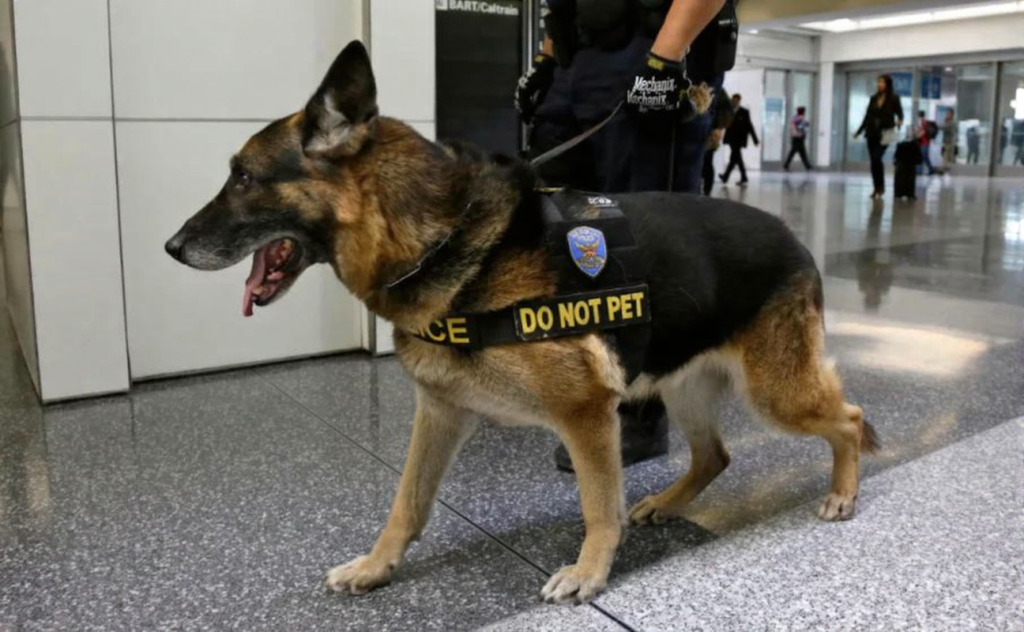
Through crowds, bags, equipment, and vehicles, dogs sweep with a rhythm machines can’t replicate. Throughput doesn’t slow them. Tech systems, on the other hand, show a delay when streams of people trigger simultaneous scans. In these environments, dogs outperform security technology because they can evaluate hundreds of scent cues continuously, without waiting for processing cycles.
Why Dogs Outperform Security Technology in Critical Detection Work
This is the core of the argument. When risk spikes, the world doesn’t act politely. As things shift and smells collide, people panic, and threats evolve. Technology works best when the environment behaves. High-threat scenarios rarely do.
The Advantage of Instinctive Judgement in Real-Time Threat Assessment
Dogs blend sensory input with instinct. They read body language, emotional energy, scent shifts, and environmental pressure all at once. Machines follow rules. Rules help until they don’t. When something doesn’t fit the algorithm, devices stall or misclassify. Dogs lean into the unknown. They don’t wait for perfect clarity.
When Flexibility Matters More Than Automation
Automation is powerful for consistency. But real threats do not move in straight lines. K9s adjust search shapes, speeds, and angles naturally. They reroute when obstacles appear. They redirect when odour fragments drift. Multi-threat situations demand adaptability, not perfection. And adaptability is where dogs dominate.
Operational Value: Why K9 Units Strengthen High-Threat Security Protocols
Beyond detection, K9s deliver operational advantages no device can replicate.
Lower Error Rates in Non-Controlled Conditions
Machines thrive in stable conditions. Yet very little in real security work is stable. On windy days, in crowded terminals, during emergencies, dogs maintain accuracy. Their performance doesn’t depend on consistent temperature or calm airflow.
The Human-Canine Team Advantage
When handlers and dogs operate as one unit, the effect is more than doubled. The handler extends the dog’s precision with strategic direction. The dog expands the handler’s awareness with sensory insight that no human possesses. Together, they create a coverage pattern that fills gaps no sensor grid can match.
Conclusion – The Detection Edge Only K9s Can Deliver
In complex, high-threat environments, dogs outperform security technology because they aren’t limited by signals, algorithms, or calibration. They read scent, intention, pressure, and movement with a fluid intelligence no device has reached. While machines support modern security, the final line of assurance often comes from a dog’s ability to make sense of chaos, track hidden risks, and adapt faster than the environment can change. That edge, deeply biological, instinctive, and irreplaceable, is why trained detection dogs remain at the centre of high-risk security planning.
Frequently Asked Questions
1. Why are detection dogs more reliable than advanced sensors?
Their sensory and behavioural processing shifts in real time, allowing dogs to handle chaotic conditions that confuse devices.
2. Do dogs still perform better in environments with heavy interference?
Yes. Interference disrupts devices, but trained K9s treat it as part of the search, not an obstacle.
3. Can detection dogs identify threats that masking agents hide?
Dogs can separate and interpret layered odours that machines read as noise.
4. Are K9 detection results recognised in professional security operations?
Absolutely. Airports, defence agencies, border units and emergency teams rely on K9 detection.
5. Can technology eventually replace detection dogs?
Tech will evolve, but it still cannot assess scent, behaviour, and environment as a combined threat picture.