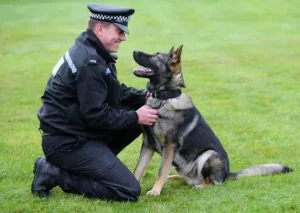
Large security sites do not come with clear instructions. There are no arrows on the ground. No signs telling a dog where a boundary begins or ends. Yet patrol dogs move through vast industrial estates, campuses, and multi-access sites with confidence and purpose.
This ability is not accidental. Dog memorising patrol routes is not a trick of instinct or a lucky by-product of obedience training. It is a learned skill, built carefully over time through exposure, experience, and controlled freedom.
Over time, these environments become familiar. Not because they are memorised step by step, but because the dog learns how the space behaves.
Table of Contents
Why Site Memory Matters in Operational Patrol Dogs
On large sites, memory is not a bonus. It is the foundation.
A patrol dog that understands its environment moves with intent. It knows when it has reached an edge. It recognises when something feels out of place. Without that understanding, movement becomes random, coverage suffers, and risk rises.
Structured recall is what separates effective patrol work from simple walking. The dog is not guessing where it is. It is checking what it expects to find against what is actually there.
When a dog does not understand the layout, small changes go unnoticed. Missed zones become habits, blind spots grow, and in live security deployments, that delay matters. The faster a dog builds site memory, the faster it becomes reliable.
How Patrol Dogs Build Mental Maps of Large Environments
Spatial Awareness Beyond Simple Direction
Patrol dogs do not memorise routes as straight lines. They do not think of left turns and right turns.
They focus on spatial awareness by dividing sites into clear zones. Open spaces, confined areas, transitions, and boundaries are treated differently.
Studies on observational spatial memory in dogs show that they learn environments by recognising spatial relationships and changes within an area, rather than memorising fixed movement sequences.
A dog understands when it has moved from one type of space into another. That shift matters more than the exact path taken. This is why dogs can change direction and still remain oriented. They remember areas, not paths.
Landmark Recognition and Environmental Anchors
Landmarks anchor memory. Not just obvious objects, but consistent features.
- A fence line that changes texture.
- A building that blocks wind.
- A surface that reflects sound differently.
- Vertical structures.
- Changes in airflow.
These details help dogs confirm where they are.
Repetition alone is not enough. A dog can walk the same route many times and still struggle if nothing stands out. Landmarks give memory something to hold onto.
The Role of Scent Memory in Route Recall
Layered Scent Memory Over Time
Scent plays a role, but not in the way many assume.
Dogs do not rely on fresh scent trails to navigate patrol routes. Instead, they recognise layers of environmental scent that build over time. Persistent smells, not passing ones, help confirm the location.
These scent layers act as background signals. They tell the dog, “This place fits.” Or, “Something is missing.”
Why Scent Does Not Replace Spatial Memory
A common misunderstanding is that patrol dogs simply follow scent. That is not how patrol work functions.
If scent alone guided movement, dogs would be pulled off task constantly. Instead, scent supports spatial memory. It confirms, rather than directs.
Navigation comes first. Scent adds context.
Training Methods That Accelerate Route Memorisation
Controlled Exposure to Large Perimeters
Learning starts small. Even on massive sites.
Early exposure focuses on manageable sections. The dog is allowed to explore without pressure. As confidence grows, zones expand. Overload slows memory formation, and too much space too soon blurs understanding. Clear exposure builds clarity.
Repetition Without Predictability
Repetition matters. Predictability does not.
Dogs revisit the same areas, but not in the same order. Entry points change. Direction shifts. This prevents route dependency, where a dog remembers a sequence instead of a space.
Memory stays flexible.
Handler Neutrality During Learning
During memorisation phases, handlers step back, giving less direction and fewer cues.
This allows the dog to process the environment on its own terms. Autonomous learning builds stronger recall. The dog is not following instructions. It is an understanding place.
How Dogs Retain Complex Site Layouts Long-Term
Memory Reinforcement Through Variability
Memory strengthens when conditions change.
Day and night feel different. Weather alters sound and scent. Human activity rises and falls. Each variation reinforces the dog’s understanding of the same space under new conditions.
This prevents fragile memory.
What Causes Memory Degradation in Patrol Dogs
Memory can fade. An extended absence from a site weakens recall. Major layout changes matter. New buildings, removed barriers, and altered access points all affect understanding.
Handler changes can also disrupt memory if working styles differ sharply. These factors require re-familiarisation, not retraining.
Common Misunderstandings About Dog Memorising Patrol Routes
- Dogs do not memorise routes the way humans do. They do not picture a map and count steps.
- They are not relying on constant handler cues. Once learning stabilises, direction comes from internal reference, not instruction.
- They are also not dependent on identical repetition. In fact, rigid repetition can weaken adaptability.
- The phrase “dog memorising patrol routes” is a simplification. What dogs really build is spatial understanding. Routes are only one expression of that knowledge.
How Complex Layouts Are Broken Down During Early Training
Segmenting Large Sites Into Cognitive Zones
Large sites are divided mentally.
External boundaries form one zone; however, internal structures form others. Transition points, like gates and doorways, act as markers. Risk areas stand out through exposure and experience.
This segmentation allows dogs to manage scale without confusion.
Why Dogs Learn Perimeters Faster Than Interiors
Perimeters are clearer. Edges are predictable. Boundaries are consistent.
Interiors change more, with furniture moving, people clustering, and sound behaving differently, which slows memory formation
Edges teach structure. Interiors teach detail.
What This Means for Real-World Security Deployment
Well-trained patrol dogs adapt faster to new sites because they know how to learn, not just what to remember. This is why well-trained patrol dogs are central to effective dog security services, especially on large or fast-changing sites where static routines fail.
As reliance on handler cues decreases, anomaly detection improves. Missing, added, or altered elements stand out more quickly.
Consistency improves across shifts because understanding is internal. Not procedural. That reliability is what makes patrol dogs effective in complex environments.
Conclusion
Dog memorising patrol routes is not a trick of intelligence or instinct. It is the result of structured exposure, careful training, and time spent learning space rather than commands.
Patrol dogs learn quickly because their training respects how memory actually works. Zones, landmarks, variation, and autonomy all play a role.
This ability sits at the core of effective K9 security work: quiet, unshowy, but essential.
Frequently Asked Questions
1. How long does it take for patrol dogs to memorise large perimeters?
It varies. Site complexity, training quality, and exposure frequency all affect speed.
2. Do patrol dogs rely more on scent or memory when navigating sites?
Memory leads. Scent supports confirmation.
3. Can patrol dogs adapt if a site layout changes?
Yes. Most adapt quickly once re-exposed to the altered environment.
4. Does handler experience affect how quickly dogs learn patrol routes?
Indirectly. Consistent handling supports clearer learning conditions.
5. Are some environments harder for dogs to memorise than others?
Yes. Cluttered interiors and frequently changing spaces take longer than clear perimeters.